Lab 3: Amplifiers
Amplification is an important part of Electrical Engineering. Amplifiers are useful when dealing with small signals. There are various types of amplifiers that are used for various purposes. In this lab, you will explore Class B and Class AB Amplifiers.Class B Amplifiers
Class B Amplifiers utilize two transistors. These transistors are an NPN and PNP Bipolar Junction Transistors (BJT). The transistors used in this lab are the 2N3904 NPN and 2N3906 PNP transistors. As shown in the circuit diagram in Figure 1, the collector of the NPN transistor is connected to +5 V, and the collector of the PNP transistor is connected to -5V. The bases of the transistors are wired together, and they connect to the input signal. The emitters of the transistors are wired together to form the output of the circuit. Note that for the purpose of the lab, the speaker has been swapped out for a resistor connected to ground.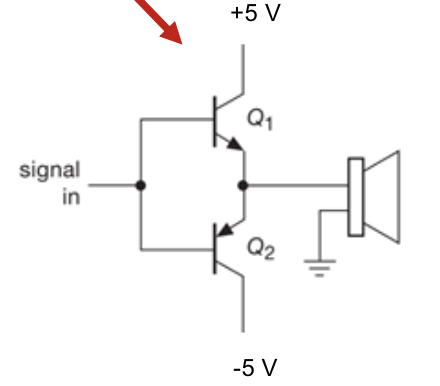
Figure 1: Class B Amplifier
Modified, Horrowitz & Hill. The Art of Electronics, 3rd ed. (2015)
The NPN transistor amplifies the positive part of the input signal, and the PNP transistor amplifies the negative part of the signal; however, the transistors do not perfectly amplify the input signal. As you can see in Figure 2, the output signal is zero near the zero-crossings of the input signal. This effect is known as the Crossover Distortion.
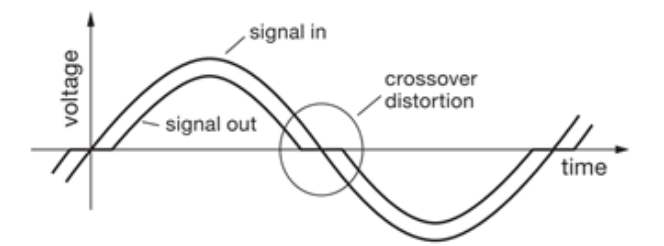
Figure 2: Crossover Distortion
Modified, Horrowitz & Hill. The Art of Electronics, 3rd ed. (2015)
Crossover Distortion occurs because BJT transistors require the Base-Emitter Junction to be Forward Biased by some voltage. This voltage is known as the Base-Emitter Voltage, V_BE. According to the datasheets for the 2N3904 NPN and 2N3906 transistors, conduction occurs when they are Forward Biased by 0.65 V. For the NPN transistor, this conduction occurs when the base is 0.65 V above the emitter, and for the PNP transistor, conduction occurs when the emitter is 0.65 V above the base. When the magnitude of the voltage drops below the V_BE, the transistor will Cut-Off and will pass a negligible current. This prevents the flow of current at this voltage level, which is why the transistors in the Class B amplifier topology have a flattened output voltage near zero crossings.
Check back soon for more updates!
ELEC244 Lab 3 Solution Guide (2).pdf